Monday, April 30, 2007

Slifkin, Klinghoffer and Evolution

Slifkin discusses the religious implications of evolution. He says there are two views among the biologists – those that consider evolution from mud to human as an incredibly fortuitous, unlikely event and those that consider it inevitable. He accepts both as a possibility.

Life – inevitable?? Earlier he said they have no idea how life could have developed from mud. How could incredibly complex self-replicating RNA or protiens form randomly (and violate the 2nd law of thermodynamics)? No one knows, but “life was bound to arise… and it will arise simlarly wherever and whenever the same conditions obtain”! [quote on p. 256] And a single cell would inevitably turn into a human, brains and all! Why slifkin considers such a view is beyond me.

He says the religious interpretation of this school of thought would be like the “Chanukah story, the ideological victory of which was that the laws of nature are seen to be programmed by God.” I’m not really sure what he’s saying; I would think the religious implication of such a weird idea is Deism.

The other “possibility”, the fact that the development of life was an amazingly unlikely process, clearly points to a Guiding Hand. But not everyone sees it this way. I can’t find the quote in Slifkin’s book, but read this quote from David Klinghoffer, an Orthodox Jew writing about Slifkin and Collins:

Something you'll often hear people say is, "Well, Darwinism doesn't mean God isn't the creator. Maybe evolution was programmed into the universe from the start. So He had no need to guide the process." The problem with such thinking is that it's directly contradicted by a major current in Darwinian evolutionary theory. In his book Wonderful Life (1989), the late Harvard paleontologist Stephen Jay Gould demonstrated what he called the "contingency" of life's history. Gould explained what an incredibly lucky break it was that Earth ever cast up intelligent life forms.
Wisely turning away from this doomed approach to showing God's hand…

It seems Klinghoffer is saying G-d couldn’t have done it, because the evolution from mud to humans was too unlikely for a designer to know it would happen. Klinghoffer then quotes a ‘brilliant’ solution:

In his most satisfying defense of belief, Collins brings forward a clever way of reconciling an unguided evolutionary process with God as the Creator. He points out that God resides beyond the limits of time. Hence, what appears to us as evolution's unpredictable course was, from God's perspective, entirely predictable. It's a neat perspective--except, perhaps, if we ask whether an unguided process of "creation" is still "creation" even if its results were foreseen.

Klinghoffer appears to be a deist, who doesn’t believe G-d could guide nature! And what exactlty is the havamina about G-d knowing the future? And what’s his difficulty with that? Maybe someone can explain it.

To Be Cont…(?)

Finalist Nebach!

Although its not official yet, it seems like I made it as a finalist in the Student blog category. Thank you to all voters! The second round of voting has been postponed to May 9th, to review the voting records. Make sure to come back and vote then!

Sunday, April 29, 2007

Slifkin on ID

R' Slifkin makes it clear he does not like the ID movement. Ignoring the scientific issues, Slifkin says ID "involves some extremely problematic theological aspects" which make it a "great danger to religion." (p. 288) His argument can be summarized as follows: ID sees G-d by pointing to things in evolution that can’t be explained naturally. Also, it’s like “G-d of the gaps” and will eventually become obsolete once science can explain everything naturally. We should see G-d in the laws of the universe instead, which are amazingly unlikely constants perfectly suited for life.

Basically, all Slifkin has done is move G-d one step further away. Slifkin is afraid that creation will be able to be explained 100% naturally like the daily running of nature. But, maybe one day, the laws of nature will be explained also! Slifkin blurs the distinction even more between him and ID in chapter two. He says the wavelength of the light from the sun is perfectly suited for life on earth. But perhaps life developed to fit the wavelength, or developed here because the sun had the perfect wavelength! How is Slifkin's view different from ID?

Slifkin says ID “denies the role of G-d in 99% of the universe”. But a person could see both the wonders of G-d in nature and even more clearly in what can’t be explained completely with chance and natural laws. Slifkin recognizes this and calls it “a slight to G-d’s creative abilities. Was He incapable of designing laws that could accomplish all His objectives, and therefor had to interfere to bring about the results He wanted?”

Does Slifkin know G-d’s Mind so well? Perhaps G-d wanted to show Himself more clearly in nature! This is the “extremely problematic theological aspect” of ID? The idea of G-d intervening in nature? A basic Jewish belief of thousands of years is suddenly a “great danger to religion"? Whatever Slifkin’s personal beliefs about miracles, how can he attack ID in such a way?

Whether you call it breaking the laws of nature, or quantum improbabilities or just extremely unlikely events, G-d’s Hand is seen in nature. This is what ID proponents believe.
For example, William Dembski, one of ID's leading proponents, said:

The fundamental claim of ID is straightforward and easy: there are natural systems that cannot be adequately explained in terms of undirected natural forces and that exhibit features which in any other circumstance we would attribute to intelligence. [emphasis mine.]

ID's position is just that nature clearly shows design. Some ID proponents even think nature could have been 'preprogrammed', a view remarkably similar to Slifkin's. For example, earlier in the book Slifkin quotes Behe:

It is fine by me if common descent is indeed true, and there is some sort of designed program to power changes over time (i.e., evolution).

But ID is necessary to explain how it all came about. Sure, Amalek could say at krias yam suf that it was just the wind, the Jews were lucky, there is no G-d. And the scientists can say about creation that it was just “natural selection” and chance. But it makes no sense without believing in a G-d who caused and guided it all. What does Slifkin have against ID?

Sunday, April 22, 2007

Science & Monotheism (draft)

R' Slifkin begins the book by pointing out that all of science is really based on monotheism. The fact that the nature has set laws that can be understood and that the universe shows such unity points to One G-d who created it all. Atheism and polytheism can’t explain such order.

The connection between Monotheism and Science can be seen in the greatest scientist of all time. Issac Newton, who discovered the Universal Law of Gravitation, recognized the unity the Universe showed. He rejected the Trinity and secretly believed in One G-d. Later in the book (p. 283), Slifkin quotes Darwin:

    I see no good reason why the views given in this volume should shock the religious feelings of any one. It is satisfactory, as showing how transient such impressions are, to remember that the greatest discovery ever made by man, namely, the law of the attraction of gravity, was also attacked by Leibnitz, ''as subversive of natural, and inferentially of revealed, religion." …

But Leibniz preffered to believe in a totally mechanistic universe with no magical “force of gravity”. He felt gravity was like saying there was an ongoing “miracle” that couldn’t be explained. This is almost the opposite of the objections against Darwin. And Darwin himself was an agnostic who didn't believe in any Divine revelation. ...


Monday, April 16, 2007

Coming up

I'm going to yeshiva today. Also, The Challenge of Creation is overdue at the library, so I won't have it anymore. I will still try to publish some posts about:
  • Science, Monotheism and Newton
  • G-d and Nature
  • Miracles & Providence
Then, I'll hopefully move on to part two in the book about the age of the universe and Genesis.
Finally, I'll get to the real issues about ID and evolution.

Friday, April 13, 2007

The Challenge of Creation

A few weeks ago, I finally read The Challenge of Creation, by Rabbi Natan Slifkin. I plan on discussing some of the ideas in the book on my blog. But first, some general comments about the book:

The book consists of 3 parts: Science, Cosmology and Evolution:

  • In the first part, Slifkin presents evidence for G-d’s existence from the laws of the Universe. He then discusses miracles, providence and natural law. Finally he shows how to resolve conflicts of Science with Torah by reinterpreting things not-literally.

  • In the second part, Slifkin presents evidence for the age of the Universe. He then discusses different approaches of reconciling the science with the Torah. He rejects these approaches and concludes that Genesis is a theological text, not a scientific one.

  • In the third part, Slifkin presents evidence for Common Ancestry, Evolution and Natural Selection. He discusses Intelligent Design, but rejects it for religious reasons. He then tries to reconcile Darwinian Evolution with Judaism. Finally, he tries to resolve the contradiction between the scientific explanation of man’s existence and the account in Genesis.

The book is filled with many quotes to give authority to the views presented. Quoting someone doesn’t prove it is true and it makes the book a slightly choppy read, but I guess it is necessary. The book is filled with controversial and sometimes irrelevant footnotes, which often raise issues without discussing them well. I thing some of them should be expanded, and others deleted. The book is overall well-written, though some phrases sound like the writing of a 17-year old. The book often gave me a déjà vu feeling because of its redundancies. The same quotes appear in multiple places in the book. Besides these minor flaws, The Challenge of Creation is an excellent discussion of critically important, but often ignored, issues.

On most issues, I probably would agree with Slifkin. I may disagree somewhat about ID or some of the book’s implications, but I’m not 100% sure about all my views. The posts to come will be discuss the actual issues.

Thursday, April 12, 2007

Leap of Faith?

R' Gottlieb of Cross-Currents recently posted about Dr. Francis Collins, discussing "a leap of faith, or what we commonly refer to as emunah peshutah." Although I'm not sure if we really have different views, R' Gottlieb seems to believe you need to first just "have faith" and only then can studying the Universe bring you closer to G-d. He implies the intellect alone won't bring a person to recognize there's a G-d. Maimonides also believed this, he claims. I commented there:

The “leap of faith” you find so appealing is a Christian concept:

Christian dogma, according to Kierkegaard, embodies paradoxes which are offensive to reason. The central paradox is the assertion that the eternal, infinite, transcendent God simultaneously became incarnated as a temporal, finite, human being (Jesus). There are two possible attitudes we can adopt to this assertion, viz. we can have faith, or we can take offense. What we cannot do, according to Kierkegaard, is believe by virtue of reason. If we choose faith we must suspend our reason in order to believe in something higher than reason. In fact we must believe by virtue of the absurd.

—The Stafford Encylopedia of Philosophy
http://plato.stanford.edu/entries/kierkegaard/#Reli


Maimonides says a person can’t believe irrational things and mentions some Christian beliefs like the one above. This is what he has to say about Emunah Peshutah:

There are some who think a lot about G-d and mention him frequently but have no knowledge and merely follow imagination or accept tradition blindly… Such people are outside of the habitation … and do not in truth mention or think about G-d. Because that which is merely in his imagination… does not correspond to any existing being at all…

—Moreh Nevuchim 3:51 translation by D. Eidensohn


Although religious belief isn’t based entirely on logic, no “leap of faith” is necessary to recognize G-d. Part of recognizing G-d may indeed be “hearing the music” and not 100% mathematical proofs. But it is still based on reason. Avraham Avinu looked at the Universe and realized there must have been a Creator. Only than, was there revelation to him. Certainly now, after the revelation to our forefathers, we need no leap of faith.

Science doesn’t just show the “plausibility of the existence of G-d”, it is very strong evidence for it. The perfection of the laws of the Universe and of DNA are are far more rational to explain based on a belief in G-d than on atheism. Atheism and Christianity require a “leap of faith”, not Judaism.


P.S.
There was only one response to my comment on Cross-Currents, and it was from some Christian who didn't really say anything

Wednesday, April 11, 2007

The Rambam on Providence & Chance.

In a famous letter to the Rabbis of Montepelier on Astrology, the Rambam clearly states his belief about Providence. He disagrees with the philosophers that all is chance, and quotes the Torah and Talmud to show that the this world is one of Providence and Reward & Punishment:

...The Philosophers claim that everything that happens... is all due to chance... We assert that that what happens to a person is not chance but rather it is the result of G-d's Judgment... The Torah warned and gave testimony that if you don't obey G-d He will punish you (Vayikra 26:14). Therefor if you assert that this suffering is not punishment for sin but merely chance you will suffer additional calamities from this "chance". This is stated clearly in Vayikra (26:27-28): If you walk with me with chance then I will walk with you with the wrath of chance. This is the root of our religion which is the Torah of Moshe - that all events that happen in the world and all suffering that happens to a person is just a decree from G-d. Thus, our sages said that there is no death without sin and no suffering without transgression (Shabbos 55a).
(translation by D. Eidensohn)

The Rambam continues:
...Here is Reuben, a tanner, poor, and his children have died in his own lifetime. And here is Simon, a perfumer, rich, and his children stand before him.
The philosopher will maintain that this is due to chance. It is possible that Reuben could become a perfumer, grow rich, and have children; and it is possible that Simon could become impoverished, turn into a tanner, and witness his children's death. All this is simply fortuitous... This is the position of the philosophers....

The true way upon which we rely and in which we walk is this: We say regarding this Reuben and Simon, that there is nothing that draws on the one to become a perfumer and rich, and the other to become a tanner and poor. It is possible that the situation will change and be reversed, as the philosopher maintains. But the philosopher maintains that this is due to chance. We maintain that it is not due to chance, but rather that this situation depends on the will of "Him who spoke, and (the world) came into being" (Ps. 33:9); all of this is a (just) decree and judgment. We do not know the end of the Holy One's wisdom so as to know by what decree and judgment He required that this should be this way and that that should be the other way; "for His ways are not like our ways, neither are His thoughts like our thoughts" (Is. 55:8). We rather are obliged to fix in our minds that if Simon sins, he will be punished with stripes and impoverished and his children will die and the like. And if Reuben repents and mends his ways and searches his deeds and walks in a straight path, he will grow rich and will succeed in all his undertakings and "see (his) seed and prolong (his) days" (ibid. 55:10). This is a root of the religion. If a man says, "But look, many have acted in this way and yet have not succeeded," why this is no proof. Either some iniquity of theirs caused this, or they are now afflicted in order to inherit something even better than this.
(translation from here.)

Friday, March 30, 2007

Blog under Construction

I upgraded the blog template for Pesach, but lost some changes. The blog will now be able to have more things on the side and be easier to edit.

Saturday, March 17, 2007

Tzoveya - Dyeing


This is the fourth Shabook. It was written by B. Goldberg and illustrated by me. These images didn't scan in perfectly, and they're even harder to figure out how to print. This time it's a larger two-sheet edition. Each corner has a page number so you know what order it's supposed to be. Directions for printing (to further confuse anyone who thinks they can) :
  1. Print out the page with the cover quarter.
  2. Print out the page with the inside cover quarter so it comes out on the back of the cover.
  3. Do the same for the bottom two pages.
  4. Put the two pages together and fold in half lengthwise, then widthwise.
  5. Cut off the top and staple the side.


Thursday, March 15, 2007

Melabain

Click on the images to enlarge. The books have to be printed out, folded and cut correctly to be in order. I might edit it sometime so it can be read on the computer. It needs a little fixing anyways.

Wednesday, March 14, 2007

Hilchos Shabbos

A long time ago, I said I would publish some Hilchos Shabbos mini-books. 4 of them have already been written. I'll probably put them on the blog this weekend. Eventually, maybe I'll publish them on Lulu.com.

UPDATE
There are 4 Shabooks in existence: Shemiras Shabbos, Gozez, Melabain, and Tzoveya. All of them are based on R' Ribiat's "The 39 Melachos". I created them because many people don't know basic hilchos shabbos and these mini-books are easy to read. They're for ages 7 and up.

Monday, March 12, 2007

Google Ads

I added some ads on the side. If an ad interests you, click on it. Since I've started the blog, there's been 6 clicks.

Update:
I've removed the ads since most of them were for things like interfaith marriages or Jesus.

Wednesday, March 07, 2007

Comments I've put on Hirhurim about ID and Miracles

(these comments were taken from the post below)

on comment "explaining" miracles:

what is the point in saying the annenei hakavod were volcanic plumes, etc.?all these things would all still be very unikely so y not just say the electrons, etc. somehow moved in just the right way so as to split seas, etc. it's the same unlikely probability. in addition what was the point in appearing miraculous? to trick the Jews of the time? if it was a miracle to them, y should we have to say it wasn't really? what exactly is the point in saying miracles weren't miraculos? the Ramban explains the purpose in having them happen, what's so problematic? miracles completely show that G-d created and cares about the world and there's Hashgacha. people who don't like the idea shouldn't like the idea of the universe being created in 10 ma'amoros either, it's the same thing - G-d appears to b doing things in a (chvsh) "cheaper" way, y couldn't He just do it w/o miracles, with only one ma'amar? but there is a reason - it adds value to the world, it shows G-d cares even about us...
people might not like the idea of law-breaking miracles b/c they don't happen nowadays, but we don't have nevuah either. there was s/t about the times of a'vodah zara that made nevuah and maybe miracles able to happen (perhaps they didn't affect bechirah as much then) nowadays it's not like that and we can't even detect those times well, the Jews' clothes didn't even wear out, they left no records.
eventually this will b discussed more on my blog.
(rav on 10 makkos)


Hirhurim, ur point is not relevant to design:

Hirhurim: This came to mind recently upon reading an article about the merits of various scientific theories by a rabbi with no advanced scientific training, in which the author declared a particular scientific theory to be "illogical" and unscientific.

me: maybe to declare a theory illogical w/o knowledge is wrong but certain conclusions can be drawn no matter what. certain issues do not require the best scientific knowledge to determine. this universe appears designed no matter what level of scientific knowledge u have. u could have lived 3819 years ago and recognized there was a designer just by looking at the universe. u could live now and with just a superficial knowledge of physics and biology and recognize the design. u could be a biochemist and see it even more. or u could be a future scientist, where it will be even clearer to the unbiased. just like a computer appears designed even without having any clue how the CPU works, so too the universe. of course, if u understand the inner workings of a computer, u'll have more appreciation of it, and the same goes for the universe. its a mitzvah to learn about the universe so u can come to greater fear and love of g-d. even though there are many scientists who look at the universe and say it's purely random, a person with much less knowledge can still realize that the scientists are completely wrong. u don't even need to know statistics and probability to tell that this universe was designed.
(fake torah and science)

anti-miracles?
while i agree w/ r' sax that we can find G-d in nature, i believe miracles r still important. they show w/o doubt that G-d exists, cares about our actions and the world and intervenes when necessary. the miracles of yetzias mitzrayim, matan torah and coming into eretz yisroel r the foundation of Judaism, and explain y we have lasted for 3300 yrs.
miracles make even the non-believer exclaim "this is a finger of G-d!". r' sacks says this is a pagan way of thinking. so when the jew saw the "hand of G-d" that was also bad? all the miracles that happened to the jews - what were they for? so they should come to pagan conclusions?
a more sophisticated approach is necessary. nature is amazing and can bring one to figure out theres a G-d, but at certain points in history, G-d performs miracles so the jews can "see" G-d.
(g-d of gaps post)

Monday, March 05, 2007

Amalek, Darwinism and Nazism (draft)

Avi Shafran of Cross-Currents recently wrote about Amalek and the worship of Randomness.
I put a comment there:

Amalek also heard about the miracle of the sea splitting, but it didn’t react like other nations - it explained the miracle “The wind was blowing, it was pure chance”. Amalek so hated the Jews implication of purpose that it attempted to destroy them, but not by abiding to any norms of war, instead attacking the weak and unprotected Jews at the rear.

Although the idea of Evolution has existed for thousands of years, and Jewish sources also say only the beginning was creation ex nihilo, until recent times most people still saw the need for a Designer. Only in the mid 1800’s was it proposed that all of the amazing miraculous creation could be explained by pure chance and a purposeless struggle between creatures.

Herbert Spencer, a Social Darwinist, invented the term “survival of the fittest”, the fundamental belief of Darwinism. Charles Darwin himself said:

We civilised men, on the other hand, do our utmost to check the process of elimination; we build asylums for the imbecile, the maimed, and the sick; we institute poor-laws; and our medical men exert their utmost skill to save the life of every one to the last moment. There is reason to believe that vaccination has preserved thousands, who from a weak constitution would formerly have succumbed to small-pox. Thus the weak members of civilised societies propagate their kind. No one who has attended to the breeding of domestic animals will doubt that this must be highly injurious to the race of man. It is surprising how soon a want of care, or care wrongly directed, leads to the degeneration of a domestic race; but excepting in the case of man itself, hardly any one is so ignorant as to allow his worst animals to breed.
(Descent of Man)
Eugenics, the application of Social Darwinism, was popular in America and Europe until the rise of Nazi Germany. The Nazis hated the idea of a G-d, but still believed in purpose to existence – the strong should dominate or annihilate the weak and rule on their own. They were big believers in Darwinism. Their antithesis was the Jews, who, as Hitler said, “The Jews have inflicted two wounds on humanity: Circumcision on the body and conscience on the soul." The Nazis therefore tried annihilating the Jews.

Although Eugenics has lost popularity, and most atheists aren't killing Jews, the idea of Darwinism that everything is just the result of randomness, without a higher purpose, is still quite common. This is similar to the philosophy of Amalek.

Friday, February 23, 2007

ID V

based on YU Honors Admission Essay A2


The Universe – Random Process or Intelligent Design?

Imagine taking a tour of various universes, looking for evidence of design. In each universe you determine its laws, and trace its development. You look at the final product, examining it for any apparent purpose. After touring several universes, you come to our own Universe. You have to determine whether or not it is designed. Here is some evidence you might consider.

The first amazing thing about the Universe is its laws and constants. If the force of gravity was a little stronger, if a neutron weighed a tiny bit more, if the universe had expanded any faster, then the universe would have been unstable, and nothing could have existed.

The best explanation scientists can come up with to explain the “fine-tuning” of the laws is the “Multiple Universe Theory”: This Universe might be just one of innumerable universes, and it is the only one where life can exist, which is why we are in it.

While explaining away a need for G-d, this theory requires a lot more faith to believe. There is absolutely no evidence for it, it is unverifiable, and it violates Ockham's razor.

There is even more evidence of design from the existence of living things. The biological machinery and DNA coding that make up the smallest cell are far more complex than a supercomputer. Scientists believe they can explain the emergence of this complexity with Darwinian Evolution.

When living things reproduce, they copy their DNA to their offspring. On rare occasions, there is an error in copying and on extremely rare occasions, the change is beneficial. An improvement in the genes of one member of a species will give that organism a better chance of survival than its fellows. Over time this can cause a change in the species.

There is scientific evidence to show this occurs on small scale and causes minor changes in species. It may even explain minor differences between similar species, such as the different beaks of birds on the Galapagos. But can unguided natural selection alone explain the great complexity of life?

Take one small example: blood clotting. In order for blood clotting to work, 16 enzymes must be present in the blood. They must interact in a precise sequence known as the Clotting Cascade. If only one of the chemicals is missing, the blood clotting will not work, and therefore the organism enjoys no advantage from having the other 15 chemicals. How can natural selection explain the emergence of such a system?

Scientists have proposed that many of the 16 components had an additional purpose which gave the organism an advantage.
Even if this is true, there is still strong evidence for design: The fact that each chemical happens to have another purpose that would allow the development of Life with with its amazing ecosystem, diversity of the species, and a mind that can contemplate it all.

After finishing with this universe, you move on to the next: a random collection of particles almost existing, before all collapsing into nothingness.

Monday, February 19, 2007

One Year

It's been a year since the beginning of Nebach! I may start posting more often.

R' Eliyahu Feinstein


YU Admission Essay (slightly edited)

R’ Elye Pruzhaner

In 1884, a terrible cholera epidemic swept through Poland and the town of Pruzhana was not spared. On the first day of selichot, Meir the coachman died, and the health authorities insisted that he be buried immediately. The Chevra Kaddisha, afraid of catching cholera, refused to carry out the burial. R’ Elye, the Rav of the town, refused to hold the selichot services. Instead, he went to the house of the deceased, accompanied by one other person. Upon seeing that R’ Elye was going to perform the burial himself, people began to gather around the house to try to persuade the Rav to let them perform the task. He remained there, until the ritual cleansing (“Tahara”) had been completed, and it was only after the burial that the synagogues were reopened for Selichot.

R’ Elye, or HaRav Eliyahu Halevi Feinstein was born in Slutzk, Russia, in 1843, and died in Pruzhana in 1929. He was my great-great grandfather and a leading rabbinic authority of his time. Many important scholars learned from R' Elye, including Rav Moshe Feinstein, his nephew and Rabbi J. B. Soloveitchik, his grandson...

R Elye held many rabbinical posts during his life, but always on one condition: that he be free from non-urgent community concerns until noon every day, so he could study Torah uninterrupted. After serving as Rav in Storbin, Kletzk, Karelitz and Reisin, R’ Elye settled down in Pruzhana. Although he received many offers to be Rav of larger cities, he preferred to stay in Pruzhana. He was twice offered the Chief Rabbinate of Israel, but turned it down because of family obligations.

In 1910, R. Elye participated in a large conference of Jewish leaders in Petersburg. He suggested that, due to changes in society, there was a need for secular education in the chadarim (Jewish day schools). He proposed that children be taught Russian and mathematics to enable them to have decent livelihoods in adulthood. The proposal was met with a lot of resistance from some of the rabbis and was not implemented. Later, the Socialists and secular Zionists were able to lure large numbers of poverty-stricken Jews to their irreligious ideologies.

Perhaps, had R. Elye's ideas been carried out, secular socialism would not have made such inroads into Judaism.

Once, a terrible fire devastated half of Pruzhana. R' Elye was abroad at the time undergoing medical treatment, but he rushed back when he heard the news. He went to the regional governor, with whom he was on good terms, and asked him a seemingly minor request: Could the government allow all building materials to be transported to Pruzhana without the usual tariff? The Russian government acceded to the request and Pruzhana became an important relay station for all of western Russia. The money saved because of the tariff exemption was used to rebuild the city, which was accomplished remarkably quickly.

In meeting R’ Elye, I would be able to see how a truly great leader balances authority and compassion, intellectual pursuits with communal responsibilities, and spirituality with worldly insight.

Sunday, February 04, 2007

Some comments I’ve put on Hirhurim (slightly edited):

Post where people were saying “eilu v’eilu” applies to modern-day jewish groups:

me: eilu v'eilu? that was about shammai and hillel. maybe it applies later but definetly not nowadays.

Some other commenter: Ah, nowadays there can only be ONE way! And coincidentally it is the way of the group that you think is right! What nonsense. Eilu v'eilu implies that there is only one correct derekh in aovdas hashem today? This is the shoresh of the problem in your machaneh.

me: only some haredim would say eilu v'eilu in a halachic dispute nowadays b/c they feel gedolim can't err and therefore if there's a machlokes, they're both right. they r taking a unique case and applying it even nowadays. the hazon ish said it may apply to certain cases among rishonim but even he agreed it doesn't apply nowadays.
that's for specific halchic disputes. as for completely different groups of orthodox judaism, what does eilu v'eilu mean anyways? Obviously, the Jews should really be one group. making different agudos (groups) is forbidden by the torah. perhaps u can say different people can have their own derech, but that's not eilu v'eilu (there's one law, just diff. people have diff. personalities, etc. and have their own way. but there's no machlokes). the best choice is just to say like we say about our religion: we're right, e/o else is wrong. (although from left to right, they may be right enough to get a share in olam haba)
(pirchei-politics)


I heard a similar story:A russian minister asked the netziv or s/o about aggaditic gemaras and he replied: If the decrees you want were signed by the czar to expel or kill the jews, a poet might say "a drop of ink drowned a million people". e/o would know what it meant but in a thousand years they wouldn't. the same with aggadata.
(R. Yisrael Salanter on Aggadata )


some commenter (paraphrased) explaining gil student’s motives : i have books to sell. i better keep on blogging about the slifkin ban even though e/o is sick of it b/c that way they'll buy the books.
Me: it doesn't really explain y all the blogs are discussing it or y people r reading it and it seems like unlikely motives. personally, i'm tired of people saying they're tired of slifkin ban discussions. it's not like making of a gadol, the ban is implying scientific facts r kefirah. the controversy around the rambam's books lasted many decades or centuries and this seems to be a continuation of it. (of course, they didn't ban the mishnah torah for saying chazal could err, only now when science has advanced so much do they realize its kefirah to believe.) (its coming)


about the ban:
the "majority of gedolim" also believe the universe is 15 billion years old. they just say 15 billion years happened in a week, which doesn't mean anything.
the slifkin books were banned because they said chazal could make a mistake in science, not because they said the universe is old.

Saturday, December 16, 2006

R' Slifkin's Response

This was in the comments of the post below, I'm moving it to the blogpage since it deserves a post of its own. Notice I changed my actual post below and my responses here. My questions are in italics, and I added numbers to slifkin's response.


Q:How are you so sure G-d wouldn't want to show directly His continued involvment in the world? How does that minimize evidence of G-d? What do you believe about miracles such as yetzias mitzrayim?

RNS:(1)It seems very strange that God would only want to show His direct involvement for a small number of specialists. Miracles such as Yetziyas Mitzrayim were exceptional events that took place for the entire nation. ID is limited for those who study cellular biology. (2)And it has nothing to do with God's direct involvement, just His involvement while creating things. (3) ID downplays and negates the idea of seeing Hashem in other aspects of nature that science can explain.
(4)Even the miracles of yetziyas mitzrayim largely took place within a naturalistic framework. (5) I strongly recommend that you read my new book The Challenge Of Creation for an understanding of why there is a strong trend amongst the Rishonim to minimize the concept of supernatural miracles.

Q:How do you explain the Mishna about ma'amaros (and pesukim) ?

RNS:(6)I don't see what this has to do with ID.

Q:Why do you have such great faith in Darwinism? Do you also believe in Freudinism and Marxism?

RNS:(7)That's a remarkably strange question. I might as well ask you why you have such great faith in Judaism - does that mean that you also believe in Freudism and Marxism?
If you want to know why I find major parts of evolution to be convincing, I suggest that you read my book, where I lay out my reasons.


My Rejoinder:

1) Many miracles happened in front of only a few people, tanach is filled with examples. Anyways, anyone can read the biochemistry behind blood-clotting or vision and understand that they couldn't have been produced by random darwinian evolution.

2) Scientists can't say "it can all be explained, there is no need for G-d" if there is proof of His involvement. Also, if there is evidence of G-d's involvement for 15 billion years prior to the creation of man, its hard to say "yea, but G-d has nothing to do with the Universe anymore".

3) How? Do miracles? They both show there's a G-d in a way thats hard even for an atheist to deny.

4) iy'H to b discussed in the future. ( in the meantime, see end of post on ma'amaros)

5) I've reserved the book at the library and hope to read it soon.

6) Read post on it. The Mishana counts ten acts of creation in the Torah and answers those who say "G-d couldv done it with one ma'amar so He must have."

7) Many people say "all those scientists cant b wrong!" and therefore believe in darwinism. but look at the other influential ideas of many decades ago. they were accepted by millions and now are obviously known to be idiotic (though still believed in by some).
a theory proposed by atheists to explain how the full complexity of the universe came about entirely randomly is ridiculous.

Wednesday, November 29, 2006

3 Questions to Slifkin

In a recent article in the Jerusalem Post, R' Nosson Slifkin declares ID to be against Judaism:

But there are also significant theological problems [with ID]. If God's existence is being demonstrated in phenomena for which there is argued to be no scientific explanation, then what about all those phenomena for which there is a scientific explanation?
...and a few papagraphs later:

So where does that leave the rest of the universe? What about all those structures that do not, even by the admission of the ID camp, present irreducible complexity? The unstated implication of their position is that these things do not attest to a Creator. Don't have a grasp of cellular biology? Sorry, you won't be able to perceive that the universe was created by God.

Either God is everywhere or He is nowhere. But He is certainly not limiting His appearance in the universe to the bacterial flagellum and the blood-clotting system.

When I wrote about this issue a while ago*, what Slifkin calls a rejection of ID I called "ID - natural process?" I explained such a view:
"They basically feel G-d could have done it with just one ma’amar so surely he did. Why ‘bother’ with 10 ma’amoros?" Slifkin is now also claiming that the ten ma'amaros would mean G-d's design can't be observed in anything else. While I understand why he wouldn't like a theory that sounds like "G-d of the gaps", I have some questions for him:
  1. How is Slifkin so sure G-d wouldn't want to show directly His continued involvment in the world? How does that minimize evidence of G-d? What does slifkin believe about miracles such as yetzias mitzrayim?
  2. How does Slifkin explain the Mishna and pesukim about ma'amaros that say G-d created the universe with many steps ?
  3. Darwinism's primary purpose is to explain how the great complexity of the universe could have happened randomly, taking away the need to believe in a G-d. Eventually, it will have its place in history with theories such as Freudinism and Marxism. Why does Slifkin have so much faith in it?
Maybe I'll post his response.


*(See "Ma'amaros and Miracles". Of some relevence is "G-d and Design".)


Tuesday, November 14, 2006

The Internet

Due to the various problems the internet pose, the haredi community has called for a full ban on its use. This approach will not work. We're already in the internet 2.0 age and the internet is becoming more and more essential. Look at the growth of the internet over the last ten years to get an idea of how big it will be in another ten years. Eventually everything will be on the internet and it will be unavoidable.
Even now, its a necessary or helpful for almost anything. You can get instant information on any topic, you can buy or sell anything, communicate with people, get torah shiurim, etc., etc. The internet is as ubiquitous as the automobile.
It's also like a car in that its dangerous, although in a spiritual way. But no one is calling for cars to be banned just because they can crash. Just like you buckle your seatbelt and drive carefully, you can do the same thing with the internet; in fact you can take stronger precautions. Depending on how much protection you want, you can put use adblock, image blockers, parental controls, web-tracking, or whitelisting. This is the correct way to deal with the problems the internet pose.
Some people think the internet is less like a car and more like the Television. The haredim have gotten along fine without TV. But the comparasion is flawed. Unlike the internet, the TV has barely any useful purpose besides killing time. In addition, a person can use the internet carefully and never see anything bad, while the television is filled with bad shows and ads.
The internet can best be compared to the printing press - it allows the proliferation of information, both good and bad, in a way never thought possible before. Just imagine how much less torah we would have if the printing press had been banned.

Friday, September 01, 2006

Direction of Prayer


Here are pictures from Google Earth with lines emanating from Israel. The purple line in the picture below shows the approximate direction people pray to. It would end up in Uganda, but the intentions bend it. The Bluish line is the actual direction to Israel.

Update: A more accurate image was added. The yellow line goes due east, towards the Congo. The white line is the direction to Jerusalem.

Wednesday, August 30, 2006

Back to School

I'm going to be going to yeshiva so I'm not sure if this blog will continue having new posts. I originally said I would blog about: Science, Miracles, Metaphors, Lakewood, Black Hats, Israel, Metzitzah and Jumping Elephants. I already wrote about the ones crossed out and about many more topics. Other topics that I would have wanted to mention: Proving Judaism, Anti-Science, Hilchos Haircuts, Hilchos Music, The Internet, and much more. Maybe I’ll figure out a way to continue blogging.

P.S.

I changed the format so all 25 posts show on the Nebach! page itself so you don't need to look at the archives.

Monday, August 21, 2006

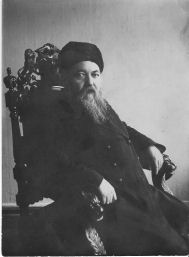
Gedolim Pictures I -- R' Menachem of Vilna


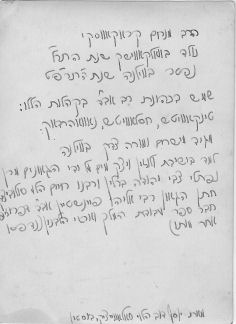
______The reverse of the picture says:

Harav Menachem Krakowski
b. in Volkovitch 5630 (1870 CE)
d. in Vilna 5689 (1930)
he was an av beis din in the following kehillos:
Tinkavitch, Haslavitch, Navordok.
Magid Mesharim and Moreh Tzedek in Vilna.
He learned in Vilna and he served the Geonim Meran Naftoli Tzvi Yehudah Berlin and Rabbeinu Chayim HaLevi Soloveitchik. Son-in-law of Rabbi Eliyahu Feinstein Av Beis Din of Pruzaner.
Author of the Avodas HaMelech and the Arzei HaLevanon (published after his death).

signed,
[his Nephew Rav] Yosef Dov HaLevi Soloveitchik (Boston)